Mesa Mark IIc+ Pre PtP
Introduction
Mark IIc+ has a reputation of being one of the most sought after amps today. Only 1500 of them were made back in the 80’s and these days they go for up to 4000-5000$ a piece. One of the players that made this amp famous is John Petrucci. Being a Petrucci fan I couldn’t resist building it, since I can’t afford to actually buy one 🙂 I decided to build a stripped-down version featuring lead channel only without fancy switching. Bass shift and lead bright switches are left in but as board mounted DIP switches. That way I can play with them to find the position I like and leave it like that.
Mods
The last preamp stage on the original IIc+ doesn’t do much as far as overdrive characteristics are concerned. It shapes bass response of the output stage which I don’t have. Voltage divider between 5th and 6th stage reduces signal level to just few volts to make it effect friendly. Since I’m building the preamp only I don’t need the last stage to boost the signal back. Instead, I converted the last stage to AC coupled cathode follower. It’s supposed to be a transparent buffer that will provide nice low impedance output that should drive any effect and long cables if needed. Since it doesn’t cut any bass, it will essentially have similar response like the original stage with deep pulled out. If you want to learn more about AC cathode followers, Merlin has a great article posted here. Large 15uF cathode bypass caps are replaced with 6.8uF poly caps. These were the largest I had and there’s no much noticeable difference in bass response between 6.8uF and 15uF.
Heaters are run at 12.6V to reduce radiation – less current means less radiation and therefore less chance of noise. Also, they are elevated to ~80V using a 220K:47K voltage divider right after the first filter cap.
Schematics
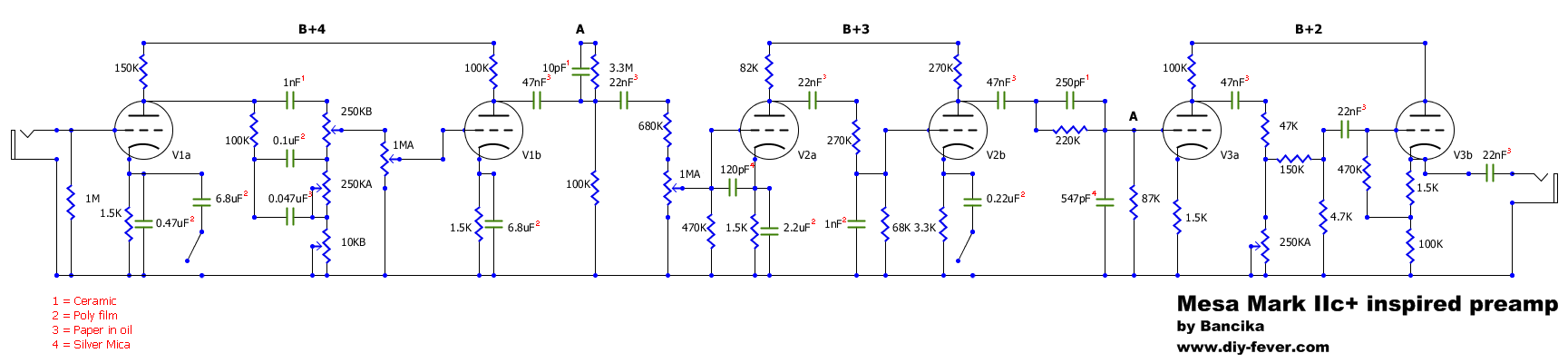
Circuit schematic – click for full size
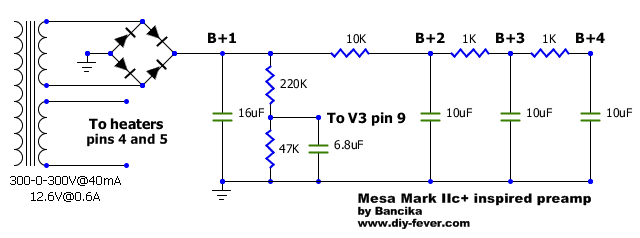
Power supply schematic – click for full size
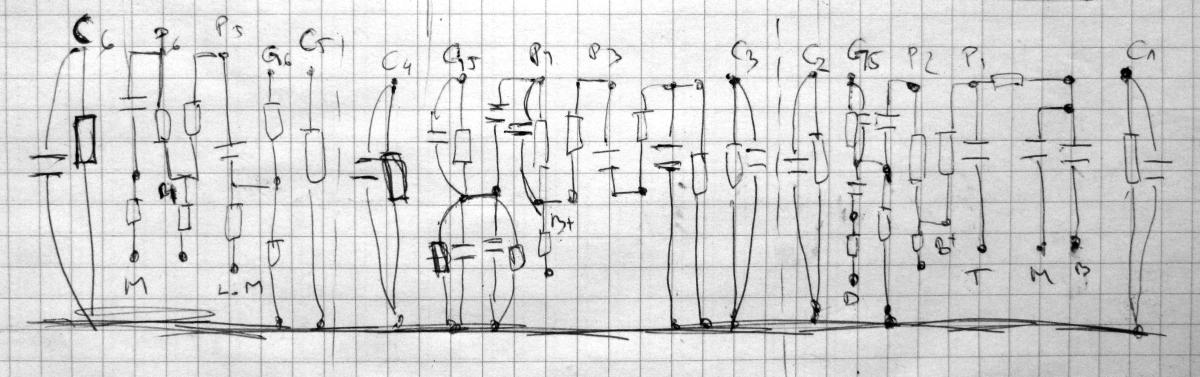
Click here to view hand-drawn layout I used to build the board. Note that it doesn’t include DIP switches and doesn’t show series resistors I ended up using for values I didn’t have. Cathodes, grids and plates are marked Cx, Gx and Px respectively, where x is tube index. T, M, B, etc markings on the bottom side are pot connections; e.g. T stands for Treble.
Parts
There are no electrolytic capacitors anywhere in the preamp! Power supply uses (giant) motor run (not motor start) poly film capacitors. As mentioned before, cathode bypass caps are also poly film. Coupling caps are mostly Russian PIO with a couple of poly film. Small capacitors in the pF range are mix of ceramic and silver mica type. Mica are notorious for being harsh when used as treble bypass/coupling caps so I used them only to shunt higher frequencies to ground. Resistors are mostly Dale and Xicon. 2W metail film resistors were used for plate resistors wherever I had that value. Transformer is a custom wound toroidal built to these specs:
- Primary: 220VAC, 30VA
- Heater secondary: 12.6VAC@0.6A
- HV secondary: 300VAC@40mA
- “Blind” winding: has only one tap and serves as a RF/EM shield
 |
Click to download parts list |
Construction
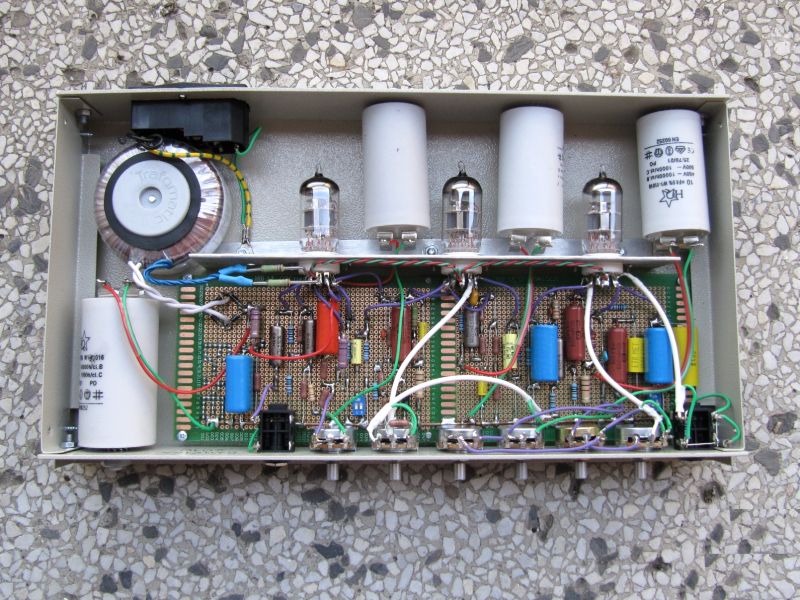
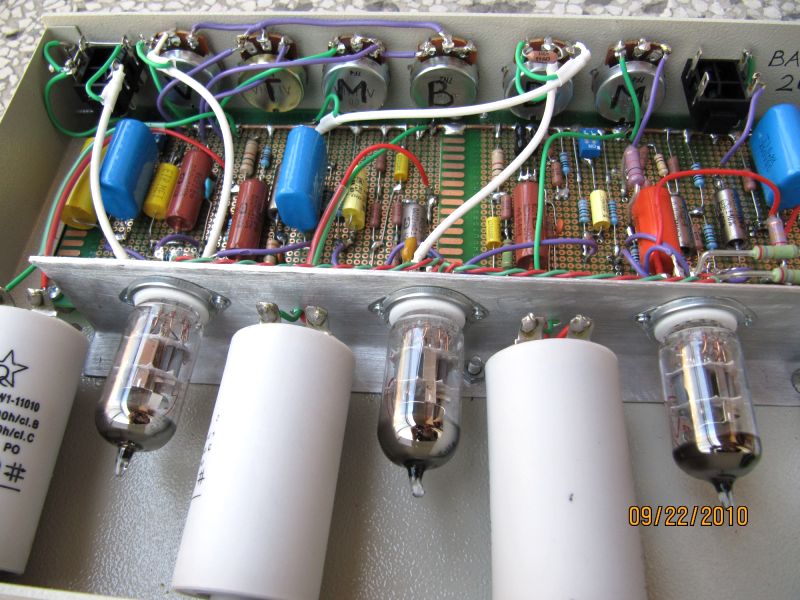
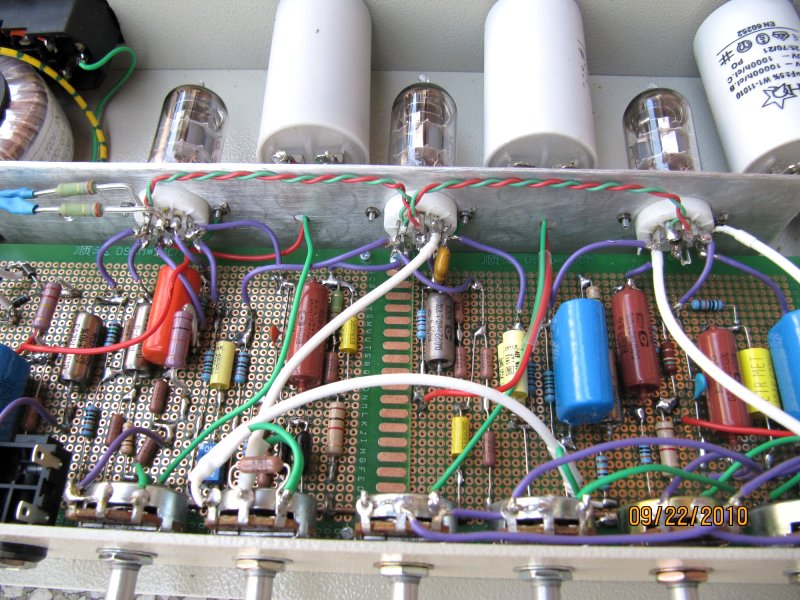
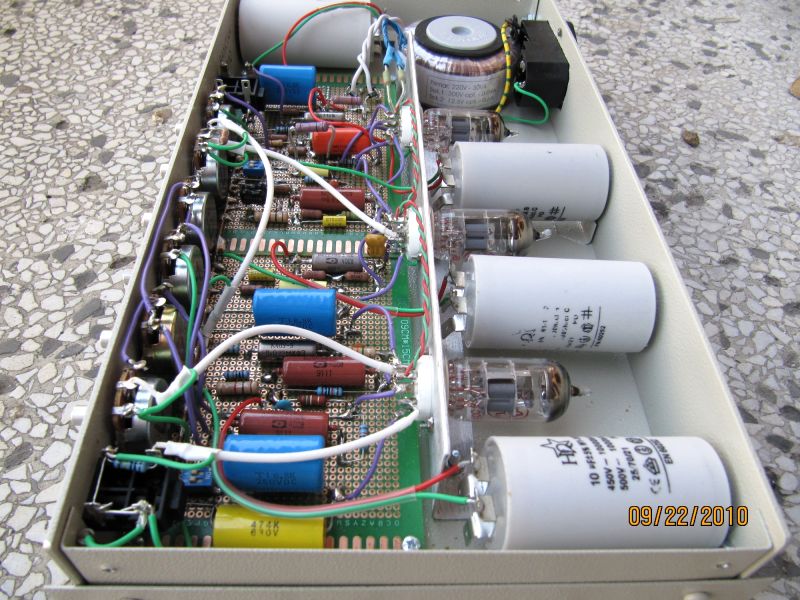
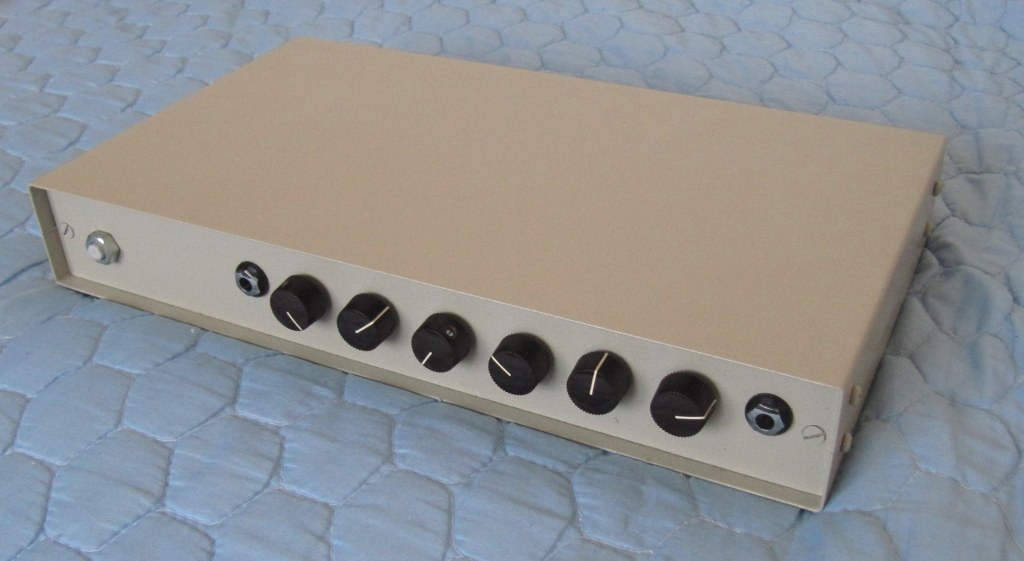
I used the same chassis like for Soldano Preamp, just a bit shorter and powder coated in cream. It’s a great chassis to work with because each panel may be removed separately. I wired the pots with the front panel removed. Tube sockets are wired before installing it back to allow easier access. Shielded wire is used on the input, from volume pot to the socket and to/from lead drive pot. For circuit board I used two fiberglass perfboards joined together. Doesn’t look as fancy as a nice eyelet board but gets the job done. As you can see below, chassis is packed tightly. Motor run caps are huge and don’t leave too much free space. A couple of times I used two resistors and capacitor to get the right value simply because I didn’t have it 🙂
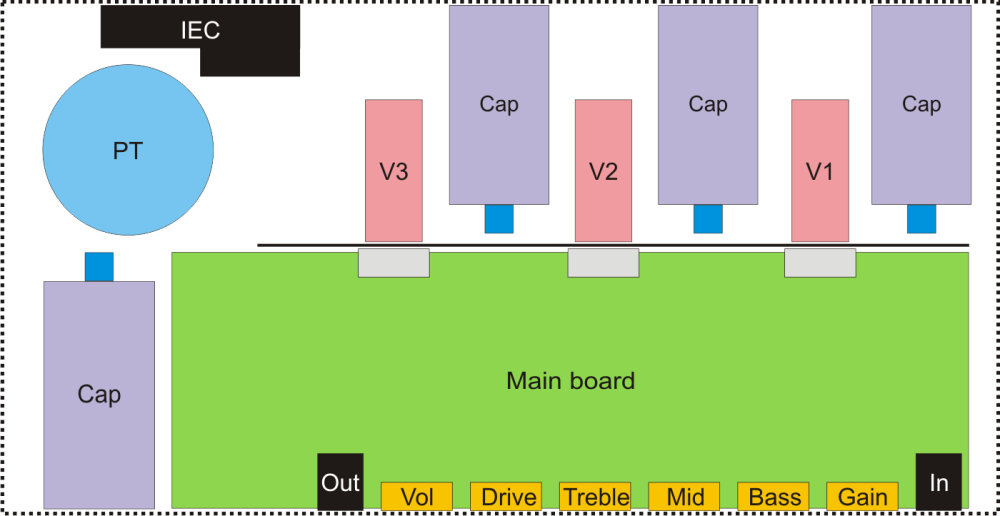
Chassis layout – click for full size
As far as grounding is concerned, (almost) strict ground bus scheme is used. Thick bare copper wire is used as a bus and is grounded to the chassis very close to the input jack. Components are grounded to the bus in the same way they appear in the signal flow. This also applies to the filter caps. First cap is grounded at the end of the bus and the rest of them are grounded close to the tubes they are powering. All shielded leads are grounded on the input side. Shield on the lead that goes to the Lead Drive pot is used to ground the pot’s lug 3, to avoid using a separate ground lead. Tube socket center pins are grounded to the closest socket mounting screw. This maybe converges from the strict bus grounding scheme, but I reckon it’s fine since it only servers as a shield. Also, internal power transformer shield is grounded directly to the chassis at the same spot where safety ground is connected.
Pictorial
Click on an image to see more details.

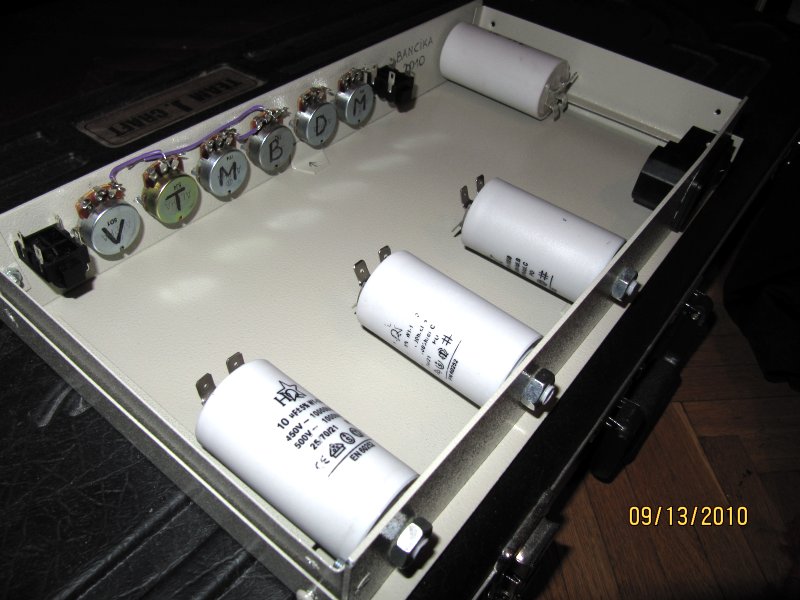


Result
The first thing I noticed is how quiet this thing is. There’s almost no noise even with both volume and drive knobs maxed. Also, it’s got noticeably less gain/distortion than my Soldano preamp. It’s expected as Soldano has a cold clipper stage and a heavily overdriven cathode follower. Those two also make Soldano sound a bit refined compare to IIc+ which is more raw. Less gain also means more useful tones. With Soldano, I set gain at 20% for rhythm and at 30% for lead. Everything above is too saturated for my taste. With IIc+, good rhythm tones start to happen with both volume and drive set above 50% and for liquid Petrucci-esque lead tones, both knobs need to be cranked up. That leaves more useful crunch tones across knob range.
Having tone stack right after the first stage is cool, but preamp alone without a graphic EQ pedal is useless. You really need to shape the frequency response after the preamp to get some usable tones out of it. Although I have all the parts for the EQ, I left it out intentionally because I plan to build it as a standalone unit. That way I can mix and match Mesa EQ and MXR EQ with Soldano and Mark preamps. Like with the original, bass knob needs to be set very low, 0-10%, to get useful rhythm tones without flabbiness.
After my experience with cloning two of the most sought after and mojo soaked amps of today – Trainwreck Express and Mesa Mark IIc+ I figured that for an amp to be famous it needs to be very bright. So if you’re out there, trying to design an amp that will be next “the sh*t”, make sure it’s bright 🙂


![John Petrucci - State of Grace [Guitar Cover]](https://i.ytimg.com/vi/K3bYjMICR5g/default.jpg "John Petrucci - State of Grace [Guitar Cover]")

If you want less bass and more clarity reduce 47nf after the v1 to something like 2n2 to 10nf, tray different values i make this mod and other mods in soldano x88r base preamp, 🙂
Hi Bancika,
I am impressed with your playing as well your pre-amp.
Built a mark1 modified clone in 2003 and it sounds great. It is all PTP.
converting it into a pcb with DIYLC tonight.
I would like to try your mark II c+. Can you email me the DIY file so I can open it in the DIYLC?
Regards
Inan
Thanks man. Check your email, I sent the DIY file.
Hi, nice work on the PCB, i’m using it with a couple of mods to get it closer to the real deal. i have a question, what is LR8?, i think it’s some kind of regulator.
Thanks for your hard work on this and sorry for my shitty english xD
Which modes did you make? Btw, LR8 is a high voltage regulator, perfect for preamps. Here’s the datasheet http://www.supertex.com/pdf/datasheets/LR8.pdf
Cheers,
Bane
i just undo the last gain stage, and used photoshop to modify your layout
Do you want the DIY file so you can open it in the DIYLC?
thanks! but it’s not necessary, i etched the board a couple of days ago and it’s working, but i’m waiting some new 12ax7’s to fully test it.
i’ll report back how it sounds
Awesome! Also, I’m interested to see how it performs noise-wise. I tried to layout components in a way that follows signal path and ground them at the filter cap. Hope it should make for a quiet layout
Cheers
Values are the no-load secondary voltage or load? Shielding
forces the primary and secondary forces? Reversible thermal fuse? Suffused
Wednesday? Design wire terminals? Suffused with the center of the rubber mat?
Painted core? Thank you for your advice.
did you use google translate, I don’t understand most of the questions 🙂
What I understand is:
* voltages are under load
* fuse is I think 100mA slo blo, mounted in the IEC
Shadows
forces the primary and secondary forces?
no comprendo mi amigo 🙁
I ask you for more details or a detailed guide to the layout of the building.
Thank
what exactly do you want to know? If it’s easier, I just finished PCB layout for it, it should be much faster the build with a PCB and also it’s a two channel version, like the original. You can find it http://diy-fever.com/temp/iic+i_full.pdf and trace transfer http://diy-fever.com/temp/iic+i_trace.pdf
Let me know if there’s anything unclear.
Cheers,
Bane
Thank you.
Sorry my English is very bad. Please be patient while we prefer to draw it.(http://www.bazarhudebnin.cz/im/mesapreampdet.jpg) Thank you for your understanding. The sound that it produces is really pretty rough.
Oh I see. For diodes you can use any rectifier diodes capable of handling 500+ volts. I recommend some ultra fast ones, like UF4007, although 1N4007 would work too.
As for heaters/switching wiring, I left those extra traces in case you use separate secondaries for switching and for heaters, like me. If you’re using one 12.6V secondary just wire it to pads named heaters, and from there you can use small jumpers to connect to switching wiring and to the first tube socket.
Hope it makes sense.
Which schematics did you reference in this build? There seems to be consensus that Boogie schematics are intentionally messed up and not to be trusted. In any case, you seem to have achieved a good sound. Congratulations. This will very likely be my first tube electronics project.
Guys from SLO Clone forum have reverse engineered real IIc+ and drew a schematic
Cheers
Hi! Sorry for bad English)
Do your have maximum level of Gain in your videos? If not, can your upload video with higher level of gain?
Best Wishes.
Hi,
I don’t have any clips with everything maxed, I usually keep gain at 75% and drive at 50-60%. Lead 1 clip is recorded with those settings, other clips are probably lower gain. I’ll try to record something and post
Cheers
Hi!
If you have recorded something with high gain, I would be also intrested to hear! Send clip with email etc.
The last uploaded video has gain set to almost max http://www.youtube.com/watch?v=AmIzyH_9F-s&feature=youtube_gdata_player
Cheers,
Bane
hi mr,,,i want ask you again with this preamp,,can i use solid state power amplifier as final amplifier with conected this preamp directly to the solid state power amplifier?
sure you can. It outputs maybe 2-3 volts so won’t overdrive solid state pedals or power amps.
Cheers
Hey man, good job really!
I want to ask you something: can i put a footswitch for change from clean to dirty? I know that it’s a preamp with only lead part but the footswitch can modify the Gain pot resistance value (like with a LDR?).
I don’t know, i was wondering. Is that possible?
Thanks and congratulations again 😉
Thanks!
I’m preparing the new version with PCB board mounted component and two channels like the original one. It uses relays for switching as they are easier to find than LDRs. Still need to verify the layout but here it is just to get the idea diy-fever.com/temp/iic+d.pdf
Cheers
hi sir,,,,your mark IIC preamp was amazing,,,
i want ask you about the power supply,,,
can i change the motor run capasitor with ordinary polarize with same value
Hi,
yes, you can use regular capacitors. You may want to wait for another week or so, I’m making a PCB layout for standard filter capacitors and radial components. Should be easier to build. And it’s two channel version, like the original. Of course, you can build just one channel if you want. Here’s the unfinished version just to get the idea diy-fever.com/temp/iic+c.pdf
Cheers
So about the transformer… I managed to find one that has a 320v secondary and a 6.3v secondary. What values would I need to change in the power supply to accommodate the transformer. Also, it is one from the 50’s in vintage amps too! 😀
Since it’s from an amp it’s probably beefier than mine and will probably drop less voltage under load. You will only need to increase the 10K resistor (after the first filter cap) to drop more voltage to compensate. I’d start with 22K or something like that, but I’d use a 5W resistor just in case. You’re dropping more voltage so there will be more power dissipated. Aim for 400VDC on B+4 node or something like that. If it’s over 400V, increase that resistor value further, if it’s below, reduce it.
Cheers
I live in the U.S. and cannot find a supplier for the AC motor capacitors or the paper oil capacitors. What would you recommend as a replacement? Also, for the transformer, would it be possible to use 2 different non-toroidal transformers both with a primary of 120vAC, with a secondary of 12.6vAC and another one with a secondary of 300vAC at 40mA?
You can find a bunch of motor run caps on ebay, here’s one http://cgi.ebay.com/10-mfd-uf-370-VAC-Oval-Motor-Run-Capacitor-NEW-/180569855663?pt=LH_DefaultDomain_0&hash=item2a0acd56af
As for the PIO caps, you can buy them cheaply from russia (ebay), that’s how I got mine. Or you can just use any poly film caps – orange drop, mallory, mustard.
And yes, you can use two transformers as described.
Cheers
Great work.
I was so inspired I built one myself. Finished last night and aside from a couple of bugs it sounds great.
Whats the transformer part number and why didnt you use electrolytics?
Transformer is custom wound to my spec (shown above). As for the electrolytes, I heard good things about motor run caps on ax84 forum. They won’t dry out as electros over time, they have very low ESR and another big reason for me is that I have them available locally. I have to order any decent electro caps from abroad, pay customs and shipping.
Cheers
Hey there Bancika! Is it possible to send me a scan of that hand-drawn layout you have previously mentioned. That would be fantastic as I would like to view the layout in conjunction with the schematic to learn more about it.
Cheers.
I’ll try to find it and if it’s still around I’ll send it to you.
Cheers,
Bane
How are you recording, what mic – position combination? Is it direct? How different do this sound live versus recording?
Cheers, amazing sound!
Thanks, appreciate it! Those are recorded direct using palmer speaker sim (PDI-09) into boss micro-br. No reverb or anything.
I haven’t tried it with a real amp yet, as I’m only using it though speaker sim and headphones (neighbors), but I’ll try it soon into the poweramp of my 5w SLO.
Cheers,
Bane
Have you tried using Mesa Boogie Cab Impulses? I´ve found on the net a couple Mark IIc+ Impulses and a few others.
Have you recorded your preamp output direct? With no speaker sim? I could try the impulses if you send me a clip of the direct preamp.
Frickin’ awesome, dude!
Would you mind sharing the layout you used? I can read schematics but I’m not an engineer (unfortunately)
Also, may I suggest using IR’s on a VST cab (like LePou’s LeCab) for your recordings instead of a hardware speaker emulation? I’ve got a feeling that it’ll sound better (if that’s even possible)!
Hi man, thanks for comments. Unfortunately, I don’t have the layout image. I sketched it on the paper and made it according to that.
I could send you hi-res photos if that would help. Using that and schematic should be enough to figure out what’s going on there.
If it’s not much trouble… would you mind sending me the pics? Thanks a lot man!
what are the B+ voltages, also, what do the switches do
B+ at the first preamp tube is 400V and a couple of volts higher on the 2nd and 3rd. Switches are for deep (pull deep on the original) and bright lead modes, but I never use them. Deep is too muddy and bright is too bright and too much gain for me.
Awesome!
I was just litlening systematic chaos 🙂
Sounds ridiculously thick man
congratulations!
now i want one myself
I can’t beleive you dare to post something like this without clips!
been following your thread at sloclone for a while now, since i also wanted to build this, but most people share your opinion (if not all) that the preamp is useless without a graphic eq.
Looking forward to sound samples of this.
Congratulations on such a nice build 🙂
Hahaha, I’ve only had it for a day, not enough time to record clips. I managed to record some rhythm tones last night. Check out video clips above.
I’ll record a couple of more and wrap them up as videos.
Cheers
Hi! Could you send me too some hi-res pics? Also wondering what order are the tube sockets’ pins? I mean socket pin numbers.
Great project! Thanks a lot
I’ll send you the pix this evening. As for the socket, it’s a standard EIA-9A socket

Thanks! I have few a more questions but let’s talk via email