DIY Layout Creator
Introduction
DIY Layout Creator (DIYLC) is a specialized software tool designed for hobbyists and electronics enthusiasts to create circuit layouts on stripboard, perfboard, PCB, and point-to-point wiring. It provides an intuitive, drag-and-drop interface for placing components, arranging connections, and visualizing circuit designs before assembly. With a built-in component library and customization options, it allows users to design layouts with precision and clarity. The software is particularly useful for designing, analyzing, and debugging guitar wiring diagrams, helping musicians and builders plan and troubleshoot custom wiring configurations for pickups, switches, and controls. Its versatility makes it an ideal solution for DIY electronics projects, prototyping, and documentation.
Project Examples
Point-to-point tube amplifier

Guitar wiring

PCB tube amplifier

Perfboard guitar effect

5-Minute Quick Start & Shortcut Cheat Sheet
1. System Requirements & Installation Quick-Check
DIYLC runs cross-platform on Windows, macOS, and Linux. The current release is built on Java 21 LTS.
Installation by Operating System
- Windows (64-bit):
- Download diylc-6.x.x-win64.exe (Installer) or diylc-6.x.x-win64.zip.
- Includes bundled Java JRE. If Windows Defender flags the file, click More Info → Run Anyway.
- macOS (Intel & Apple Silicon):
- Download diylc-6.x.x-osx-silicon.zip (M-series) or diylc-6.x.x-osx-intel.zip.
- Extract and drag DIYLC.app to your Applications folder.
- If macOS blocks launch, navigate to System Settings > Privacy & Security and select Open Anyway.
- Linux (64-bit):
- Download diylc-6.x.x-linux.zip, extract, and double-click the executable AppImage.
- Universal Package (All Platforms):
- Requires Java 21+ installed (java -version).
- Run via run.bat (Windows) or run.sh (macOS/Linux).
2. Interface Overview
- Component Library (Left Drawer): Browse components grouped by category (Boards, Passive, Semiconductors, Guitar, Tubes, Schematics, Shapes).
- Canvas (Center Area): The grid-based work region with adjustable rulers (mm/inches) and zoom controls.
- Properties & Layer Tree (Right Panel): Displays properties of selected components and Z-order layer management.
- AI Assistant (Right Drawer): In-app chat for troubleshooting, design tips, and circuit questions.
3. Essential Key Commands & Controls
- Q: Jump to search the component tree.
- ~ (Tilde): Repeat and place another instance of the previously created component.
- Ctrl / Cmd + D: Duplicate selected component(s).
- Ctrl / Cmd + E: Edit selected component properties (value, package, color, etc.).
- Alt / Option + Left / Right Arrow: Rotate selected component(s) counter-clockwise or clockwise.
- Arrow Keys: Nudge selected component by one grid increment.
- Shift + Arrow Keys: Nudge selected component by one pixel for precision alignment.
- Shift (while dragging): Lock movement along a single axis (horizontal or vertical).
- Ctrl (while dragging): Temporarily toggle Sticky Points to prevent unwanted snapping.
- Ctrl / Cmd + G / Ctrl / Cmd + U: Group or ungroup selected components.
- Ctrl / Cmd + 1 – 6: Toggle visibility of layers (Chassis, Board, Trace, Component, Wiring, Text).
- Ctrl / Cmd + F: Find a component by name, select it, and pan to it on canvas.
4. Key Workflows & Features
Creating a Layout
- Place a Board: Drag a Veroboard, Perfboard, or PCB shape from the Boards category onto the canvas.
- Add Components: Drag resistors, capacitors, transistors, or ICs onto board holes/pads.
- Route Connections & Wires: Use the Connectivity menu to add flexible wires, jumpers, trace cuts, or ground busses.
Analysis & Debugging Tools (Analyze Menu)
- Guitar Wiring Analyzer: Verifies switch matrix combinations, coil splits, phase relationships, and hum-canceling positions.
- Virtual Multimeter: Graphically traces electrical paths between two points as series/parallel sub-circuits.
- Compare With…: Compares two layouts or schematics to check if they are electronically equivalent.
- Highlight Connected Areas: Click any point/node to highlight all connected paths on the board.
5. Exporting & Sharing Your Work
- Image / PDF Export: Go to File > Export Image/PDF for high-resolution documentation.
- Bill of Materials (BOM): Go to File > Export BOM to generate a complete list of required parts and quantities.
- Gerber PCB Fabrication: Go to File > Export Gerber to generate manufacturing files for PCB fabricators.
- DIYLC Cloud Integration: Use the Cloud menu to search, download, and publish community layouts.
6. Keeping DIYLC Updated
- Look for the glowing lightbulb icon in the bottom-right corner of the status bar when an update is available.
- Official download channels: GitHub Releases and Patreon.
- Mac users: in most instances, the Gatekeeper will block DIYLC and mark it as damaged because it’s a 3rd party app from an independent vendor (me). This document covers how to allow DIYLC on your Mac. Alternatively, all Patreon supporters get access to an Apple-notarized version of DIYLC that is hassle free.
- GitHub Release Page – get the latest version for all platforms.
- GitHub Wiki Pages – to access user documentation as well as developer documentation.
- GitHub Issues Page – to request a feature or report an issue or bug.
- Patreon – support further development and get access to exclusive content, AI credits and hassle-free Mac builds.
- Cloud Project Browser – to browse, search and download community .DIY files.
- Discussion Group – for any questions of DIYLC-related discussion with the wider community.
- 🆓 Free for Life: A true old-school offline app—the app you download is yours forever and the files you created are yours.
- 💻 Platform Independence: Runs locally on any machine capable of running Java JRE/JDK 21 or newer.
- 🖱️ Intuitive UI: Easy-to-use interface; most operations can be done seamlessly with a mouse.
- 🎛️ Versatile Designs: Draw PCB, perfboard, stripboard, or point-to-point layouts, schematics, guitar wiring diagrams or custom faceplates.
- 🔌 Highly Extensible: API allows custom plug-ins and new components to be added easily.
- 🚀 Optimized: Improved performance and reduced memory consumption.
- 💾 Smart Defaults: Save default values individually for each component property.
- 🖨️ Export Options: Export outputs to image, PDF, or printer.
- 📄 Toner Transfer & Gerber: Export PCB trace masks for toner transfer or Gerber files for fabrication.
- 📋 Bill of Materials: Create a BOM within the project or export to multiple file formats.
- 🔍 Guitar Wiring Analysis: Analyze guitar wirings and visualize detailed pickup configurations for each switch state.
- ☁️ Cloud Integration: Share your projects, search the cloud, and download other users’ designs.
- 🤖 AI Powered: Features a built-in AI assistant to help answer general electronics questions, guide you through DIYLC’s usability, and provide insights or troubleshooting for the specific circuit you are designing.
- ⚡ Circuit Analysis: Various tools aimed to help you debug and analyze your circuits.
- 📈 SPICE Netlists: Export circuits directly to SPICE-compatible netlists.
- Version 1 (2006): Written in Delphi for Windows. It was tailored strictly to guitar pedal circuit boards (vero, perfboard, and simple PCBs) and instantly replaced generic graphics software within the pedal-building community.
- Version 2 (2008): Rewritten in Java to enable cross-platform functionality and introduced an XML-based component format. While it expanded into schematic and chassis wiring diagrams, defining components as purely visual primitive shapes limited custom behavior, impacted performance, and lacked backwards compatibility with Version 1 files.
- Version 3 (2011): Completely rewritten from scratch, made open-source, and redesigned with a modular “component-as-code” architecture. It introduced full backwards compatibility, vacuum tube and guitar wiring component libraries, and DIYLC Cloud for sharing layouts.
- Version 4 (2020): Modernized on Java 8, introducing initial circuit analysis and debugging features that turned DIYLC into an interactive design assistant.
- Version 5 (2025): Upgraded to Java 17 and Maven, introducing built-in AI tools (AI Assistant and AI Analyzer) and Apple-notarized macOS distributions.
- Version 6 (2026): Adopted Java 21 to enhance runtime efficiency, memory management, and overall system performance, solidifying a stable foundation for ongoing AI-assisted design features. Expanding to modern DIY projects including SBC’s, displays, sensors, etc.
- Become a Patreon.
- Make a one-time donation with PayPal.
- Help with adding the information to the user manual or other project documentation.
- Extend the component base, read this wiki to learn how to create new components.
- Add a new functionality though plug-ins, read this wiki to learn how to create new plug-ins.
- Big thanks goes to folks from the following online communities for contributing ideas and helped test the app: DIY Stompboxes, AX84 and Free Stompboxes.
- I’m happy to report that DIYLC 4 is the fastest version ever. YourKit Java Profiler helped tremendously with memory and performance profiling and pointed me to places in the code that took longer to run or consumed more memory than I’d like them to. I strongly recommend this tool to anyone developing Java or .NET applications because it helps finding bottlenecks and allocation hot-spots very fast.
YourKit is kindly supporting open source projects with its full-featured Java Profiler.
YourKit, LLC is the creator of innovative and intelligent tools for profiling Java and .NET applications.
Take a look at YourKit’s leading software products: YourKit Java Profiler and YourKit .NET Profiler -
[…] As usual, I prepared one possible layout with DIY Layout Creator: […]
-
[…] Then I drew up the perf board model in DIYLC […]
-
[…] Drawing layouts and schematics with DIY-fever.com’s app (link); National Geographic’s ‘The […]
-
[…] use DIY Layout Creator to prepare for breadboarding. This step is not strictly necessary, but I prefer to do it this way. […]
-
[…] DIY Layout Creator (for perfboard layouts) […]
-
[…] out a circuit on vero or perf board. Like a lot of DIY pedal builders, I like to use the software DIY Layout Creator—it is a great tool for those of us small-timers working on a pretty minimal budget. It is free, […]
-
[…] design was made with DIYLC. The board only contains an LM7805 to power the microcontroller. It uses a DS18b20 digital […]
-
[…] layout created with DIYLC. Mounted on a piece of wood. The ISP header is on the right side. Reset button and LED are for […]
-
[…] I start soldering the circuit on the perfboard, I usually like to use DIYLC, which is a very nice and easy to use software for designing simple circuits like this one on a […]
-
[…] make our lives easier, we designed the board to a freeware layout program for strip boards. The advantage of this procedure was that by doing this we were almost ready to […]
-
[…] – DIY Layout Creator:http://diy-fever.com/software/diylc/ – Hi-Voltage Effects Loop Mod:http://amzn.to/2BJP98s – Amp Garage […]
-
[…] wygenerowania tych rysunków wykorzystałem program DIY Layout Creator. W sieci można znaleźć wiele podobnych narzędzi, ale jeszcze nie miałem okazji przetasowania i […]
-
[…] nehme den DIY Layout Creator (in der Version 1.x, da ich mit der 2.x nicht klargekommen bin; mittlerweile gibt es aber auch […]
-
[…] ja taitoa käyttää sitä. Toki hommat onnistuu reikälevylle ja niitä voi piirrellä helposti Diy Layout […]
7. Useful Links
Features
The 20-Year Story & Vision
The Origins (2006)
DIY Layout Creator began in 2006 with a post by Branislav Stojković (bancika) on the DIY Stompboxes forum. At the time, pedal builders relied on generic graphics applications like MS Paint or Visio, tediously copy-pasting components from hand-drawn templates to map out stripboard and perfboard layouts. DIYLC was envisioned as a free, dedicated tool designed by a builder specifically for fellow makers.
Evolutionary History
Project Vision
DIYLC is maintained primarily by a single developer but remains deeply rooted in the open-source DIY maker community. Unlike complex professional EDA suites (e.g., KiCAD or Eagle), DIYLC’s core philosophy is to remain focused, fast, and accessible. It prioritizes real-world, practical DIY workflows—such as point-to-point wiring, board layouts, and wiring diagrams—making the design and documentation process clear and enjoyable.
Master DIY Layout Creator and streamline your design workflow!
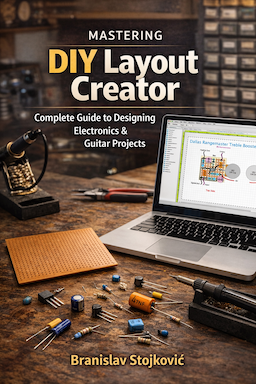 |
The Official DIYLC Guide (v1.0) is a comprehensive 174-page eBook that goes way beyond the basics. It features step-by-step design workflows for everything from multi-layer PCBs to hot-rodded point-to-point tube amps. Learn to master advanced tools like the Virtual Multimeter, Netlist generation, the Guitar Wiring Analyzer, and the new AI Assistant. Click here to grab your copy! Buying v1.0 guarantees you free lifetime updates as the app evolves. Active Patreon supporters get an additional 50% off or a completely free copy. Check the Patreon feed for your VIP link! |
Want to contribute?
DIYLC is provided free of charge and can be used and redistributed freely. Please note that it takes a lot of time and effort to build, test and maintain it and to interact with the growing community of users. If you find DIYLC useful and want to support further development, these are some of the ways you can contribute
License information
Source code is released under GNU General Public License version 3. Contact the project owner to obtain a license in case you plan to use the source code, or any part of it, in commercial purposes.
![Lost Without You - John Petrucci [Guitar Cover]](https://i.ytimg.com/vi/CvhLPmLvHVM/default.jpg "Lost Without You - John Petrucci [Guitar Cover]")



I can not figure out how to get an icon on my desktop to click which will open the application. When I select any one of the files, I have to choose an application to open it with. Also, if I double click on “diylc.jar” it will open the application and I can then get to my project. However, this seems very odd and unconventional. It is like I am having to make it work. I get that you say to select File->Open. My problem is to get the DIYLC open and running so I can select File and Open my project. I hate to be such an idiot about this, but I am trying.
Thanks for all your help!
Doc Joe
Ok, I have once again tried to get diylc onto my MAC. I understand you said to “cd” to diylc3. When I am in terminal mode and type cd \diylc-3, I get nothing except error. I need a script or something. I do not have the sophistication to run didly in terminal mode. I mean I need specific, key for key stroke instructions and EXACTLY what I need to type in. I am no dummy, I just don’t get this. Sort of like, Where would you begin to open up the insides of someones brain? That is simple for me. Is it for you? I am guessing you would want me to walk you through step by step. Well that is where I am with this. Hope that helps you understand what I need.
Thanks,
Doc Joe
You could try to execute the run.sh script directly from the folder. Right click on that file, open with, terminal or something and it should work.
I opened it with Terminal and Text Editor and no go. I may just have to buy a PC for the sole purpose of running DIYLC. I do hate to do that though.
I copied what Terminal returned. Maybe it would mean something to you.
“/Users/drjoseph…/Downloads/diylc-3/run.sh ; exit;
Drs-iMac:~ drjoseph…$ /Users/drjoseph…/Downloads/diylc-3/run.sh ; exit;
Exception in thread “main” java.lang.NoClassDefFoundError: org/diylc/DIYLCStarter
Caused by: java.lang.ClassNotFoundException: org.diylc.DIYLCStarter
at java.net.URLClassLoader$1.run(URLClassLoader.java:202)
at java.security.AccessController.doPrivileged(Native Method)
at java.net.URLClassLoader.findClass(URLClassLoader.java:190)
at java.lang.ClassLoader.loadClass(ClassLoader.java:306)
at sun.misc.Launcher$AppClassLoader.loadClass(Launcher.java:301)
at java.lang.ClassLoader.loadClass(ClassLoader.java:247)
logout
[Process completed] ”
Hope it means something to you.
Doc Joe
try typing this
cd /Users/drjoseph…/Downloads/diylc-3/
./run.sh
(if not, try without …)
I sort of got it to load and can bring up the application now. However, if I close the application and try to re-open my “test1.diy” there is not an application to open it with. I am in the directory with all the diylc-3 files. (which I put on my desktop). Any suggestions?
Doc Joe
You have to open the app and File->Open from there