Mesa Mark IIc+ Pre PCB
After building and using the single channel version of IIc+, I wanted to do a full blown two-channel version. Instead of expensive and not so easy to find optocouplers, I decided to go with readily available and cheaper non-latching small signal relays.
What makes the IIc+ sound?
- Clean signal mixed with overdriven signal all the time. As you can see from the schematic, the only part of the circuit that gets cut off is lead circuit, clean signal path is always on. In lead bright mode, lower frequencies (and even some mids) of the distorted signal will be cut significantly by the 220nF cathode bypass cap. But clean signal added to the mix later will help bring back some of the lows that are not overdriven and flabby.
- Pre-distortion equalization. You can fine tune your guitar response before the signal gets distorted, so you can prevent the sound from being flabby or hash. That also means that you’ll need some sort of post-distortion equalization. Most marks amps have the built in 5 band graphic EQ. I use graphic EQ pedal to shape the sound of distortion.
- A lot of high-frequency shaping. There are a few capacitors going from grid to ground or to a cathode, or across the plate resistor. All of them cut very high frequencies. This prevents hi-end oscillations, but also removes some harshness.
Mods
- Already mentioned relay switching instead of optocouplers. I used Finder 30.22, but there are many other options, like Omron G5V-2, Takamisawa RY12W-K. There’s a separate power supply for switching circuit, to keep it isolated from audio stuff, but you could use heater supply to power relays.
- Regulated high voltage power supply, using Supertex LR8 to regulate B+ to 385V. It’s a really cool little regulator. As long as you have at least 12 volts above the target voltage, it will regulate the voltage to 1.2 multiplied by the ratio of the two bias resistors. In this case, I got 180K and 560ohm resistors which produce 385V. It can take up to 20mA which makes it perfect for tube preamps. Click here to download the data sheet.
- Separate master volume controls for Clean and Lead channel.
- The last gain stage is converted to AC coupled cathode follower. There’s no need to boost the signal further because you will usually place some EQ/delay/modulation pedals after the preamp, so it’s important to provide smaller pedal-friendly signal not to fry them. Also, cathode follower acts as a buffer and outputs nice low impedance signal, like FX loop send.
Schematic and Layout
I drew these with my own DIYLC software, click to see the larger version.
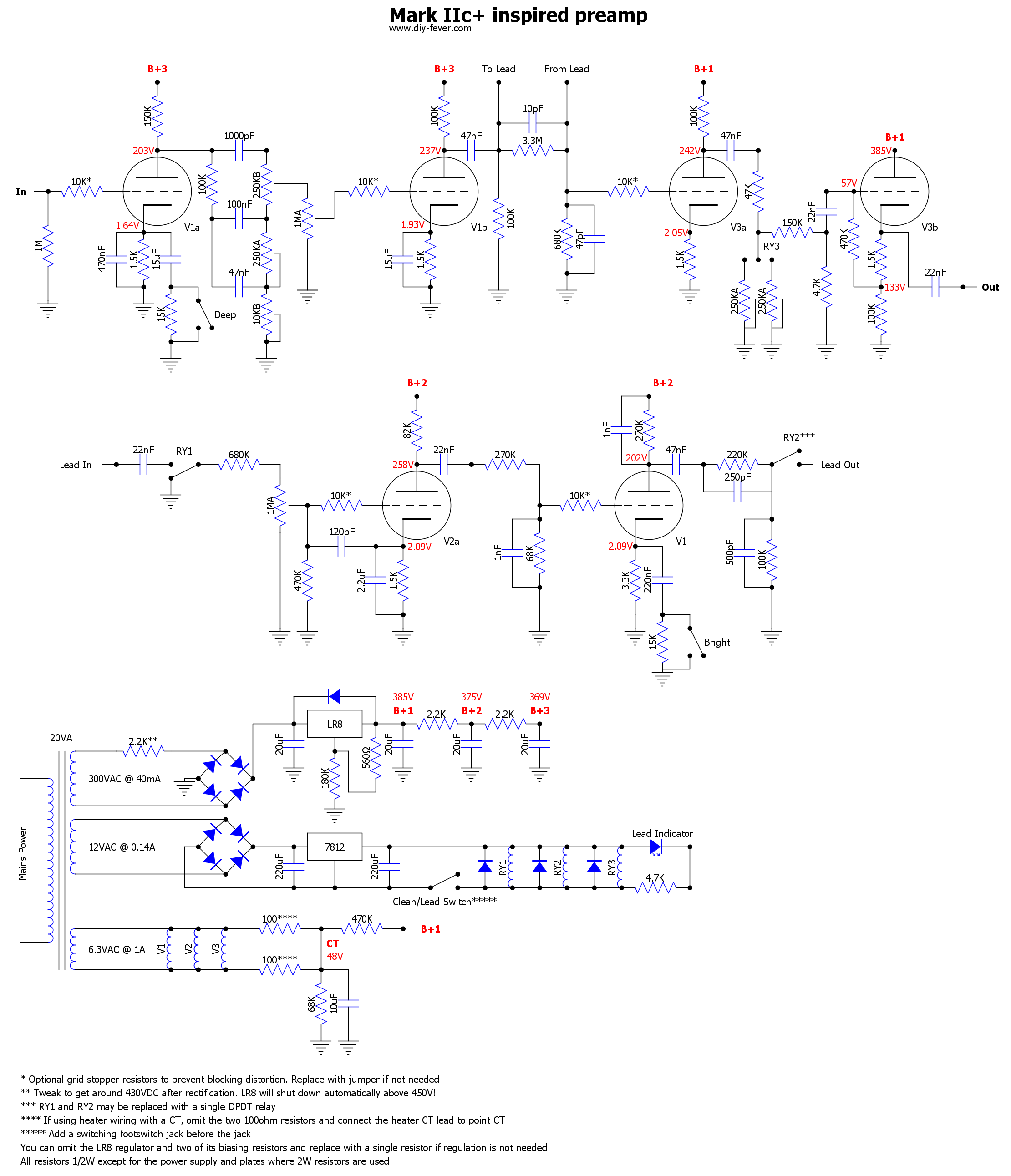
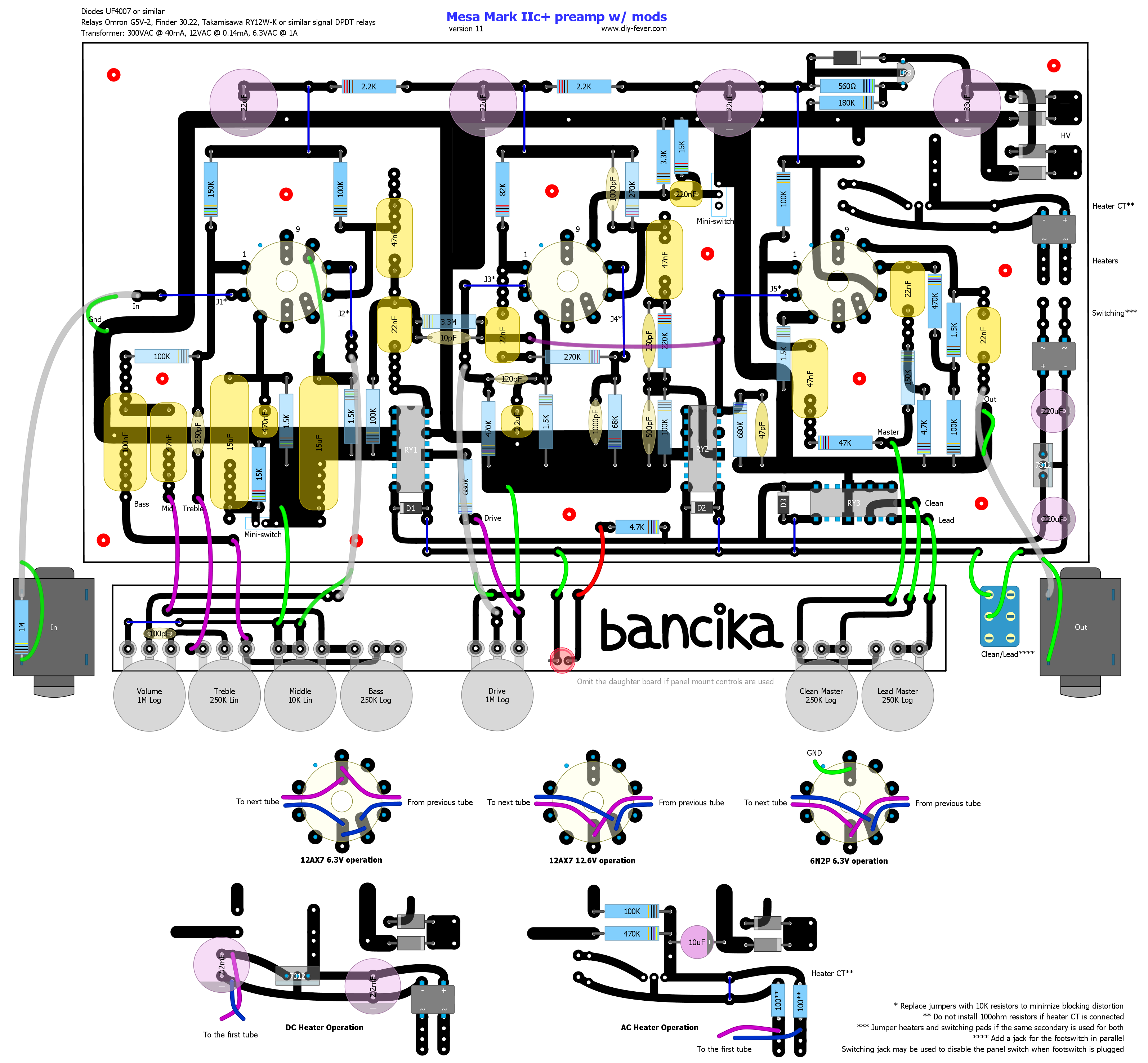
Click here to download printable trace mask for etching your own PCBs. Make sure to turn OFF the option to scale the document to page size when printing.
Click here to download DIY Layout Creator file of the layout. It’s not the latest version matching the rendered layout above, but that’s the latest I could find on my backup drive.
Wiring Options
- Tube socket is flexible to allow 6.3V or 12.6V heaters using 12AX7/ECC83 tubes or 6.3V using Russian 6N2P(-EV) tubes. Refer to the layout diagram to see how each of the three options should be wired.
- Regardless of tube type or voltage, you can supply heaters with AC or DC current. DC requires few more components and higher input voltage, but can yield lower noise level. It’s advisable not to run DC heaters with 6.3V because three tubes will draw 900mA which will run the regulator very hot. You’ll need to mount a heatsink.
- Heater elevation circuit (10uF capacitor and 100K/470K resistors) is optional and should be used only with AC heater supply. Refer to the bottom section of the layout diagram to see the difference.
- Real or virtual center tap options. If your power transformer has tapped heater secondary you can omit the two 100ohm resistors that form a virtual center tap in AC heater mode and connect the real center tap where noted. You can also just terminate the real center tap and use the virtual one.
- If your high voltage secondary has a center tap (300-0-300V), you can omit two of the four rectifier diodes that have their cathodes pointed to the HV pads and connect the center tap to the ground pad.
- Separate secondary for powering relays, or sharing the heater secondary. If shared, two jumpers should be installed between heaters pads and two pads leading to the relay supply. In that case, note that relay voltage should match your heater voltage, so use the appropriate relays and regulator.
- In front of each of the 5 triodes’ grids there’s room to install a small grid resistor to eliminate risk of blocking distortion and reduce risk of RF noise. Layout shows jumpers J1-J5, but you can put a small (10K, maybe even smaller) resistor that shouldn’t affect the tone noticeably.
- If high voltage regulation is not needed you can always bypass it. Just omit the LR8 regulator, two biasing resistors and replace the diode with a jumper.
Construction
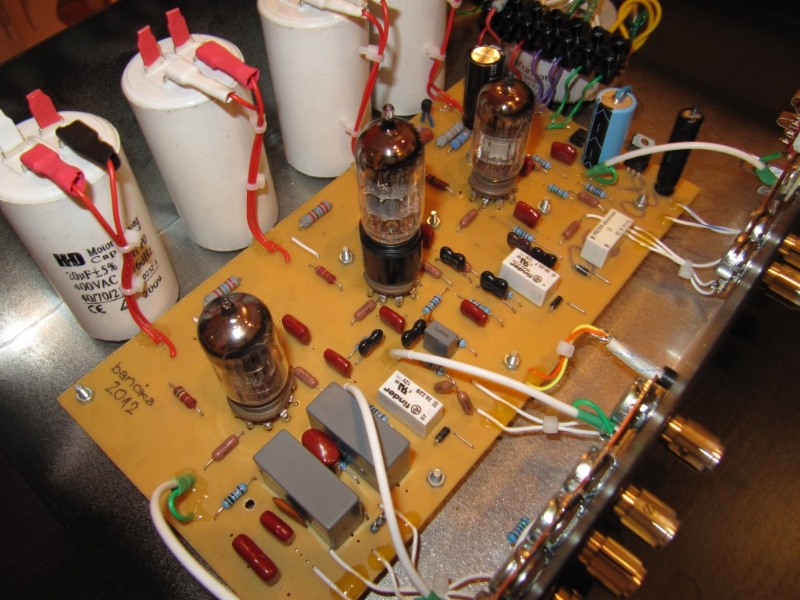
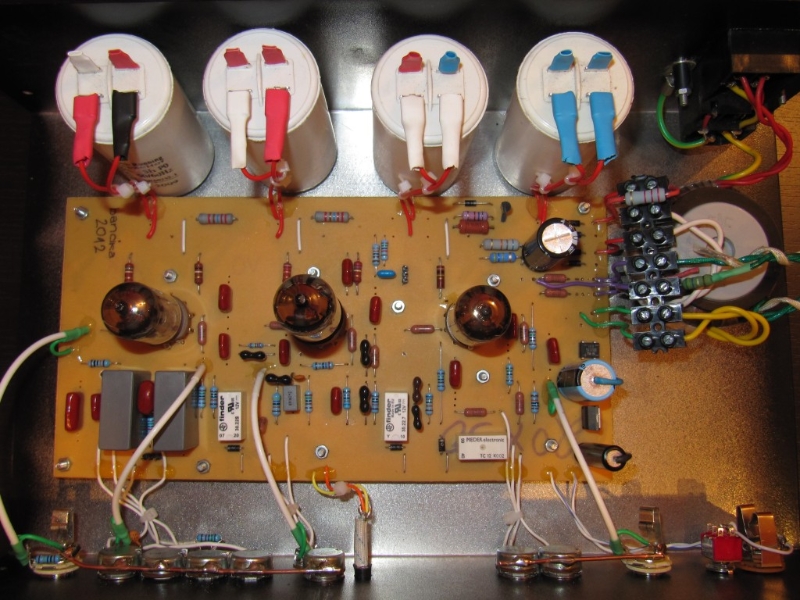
This time I opted for PCB-based construction to allow for easier assembly and for the other people easily etch their own boards. I’m usually not a fan of board mounted components, so only tube sockets are left on the board. There’s a separate daughter board in case you use board mounted pots, but it’s optional. I didn’t use it in my build.
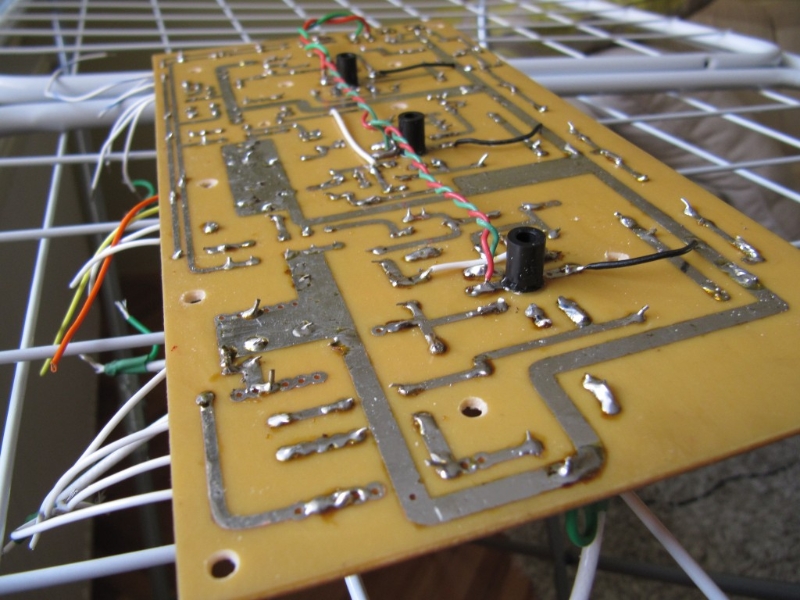
I took number of steps to mitigate reliability issues that may be caused by board mounted tube sockets. The main issue is that mechanical movement of the socket caused by inserting and removing a tube may cause joints to crack and traces to be lifted.
- Socket pins are bent inwards to ensure good mechanical connection
- Sockets are epoxied to the board
- There are many mounting screws and standoffs to ensure the board doesn’t flex
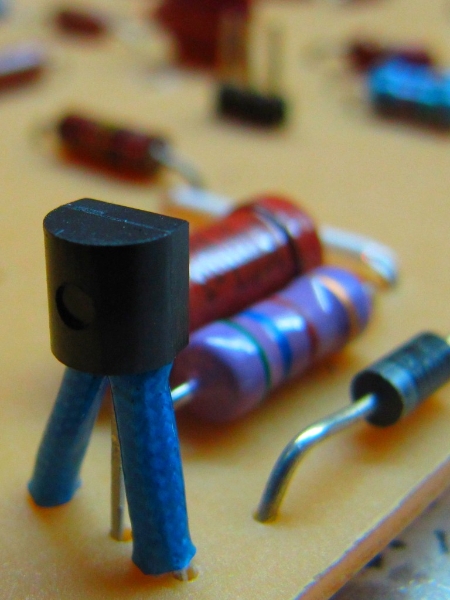
- I glued a plastic standoff below each socket to reduce stress when inserting a tube (see photos)
- I used a small piece of L-shaped wire to make better solder connection between each pin and copper trace leading to it (see the drawing below). That way I increase joint surface between copper and the pin
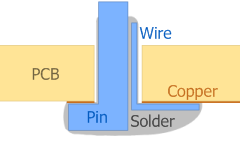
All the components on the front panel are soldered to the main PCB, but filter capacitors and the transformer are connected to the board using non-soldered terminals. That allows for easier disassembly in case need to debug a problem or replace a component.
Parts Choice
I was very happy with russian military tubes in my SLO build, so I wired the board to accept 6N2P-EV tubes. They are near ECC83/12AX7 equivalents with 6.3V only heater wiring and internal shield between the triodes. They are low noise and long life and sound really good. To bring some of that warmth of JJ ECC83 tubes, I used a conversion socket that allows for ECC83 to be plugged into a socket wired for 6N2P. After some experimenting I settled with two 6N2P-EV in outside positions and JJ ECC83 for the lead circuit.
This time I wanted to experiment with poly film coupling capacitors (the first version was using paper-in-oil), so all the coupling caps are poly film. Again, I tried to stay away from electrolytics, so cathode bypass caps are 15uF poly film blocks and filter caps are 20uF 400VAC motor run caps. The only place where electrolytics are used is the supply for relays and heater elevation circuit. None of them should influence the sound. Capacitors in the pF range are mix of ceramic and silver mica, whichever I had in my parts bin.
As far as resistors go, I used a mix of Dale and Xicon 1/2W resistors for the most part. Plate load resistors are 2W KOA with the exception of the 5th stage where I used a 1/2W carbon comp resistor to add some mojo 🙂 Power supply uses 2W or 3W resistors.
- 20VA core
- 230V primary
- 300VAC @ 40mA secondary
- 12VAC @ 0.14mA secondary
- 6.3VAC @ 1A secondary
* All voltages are under load
Need a Footswitch?
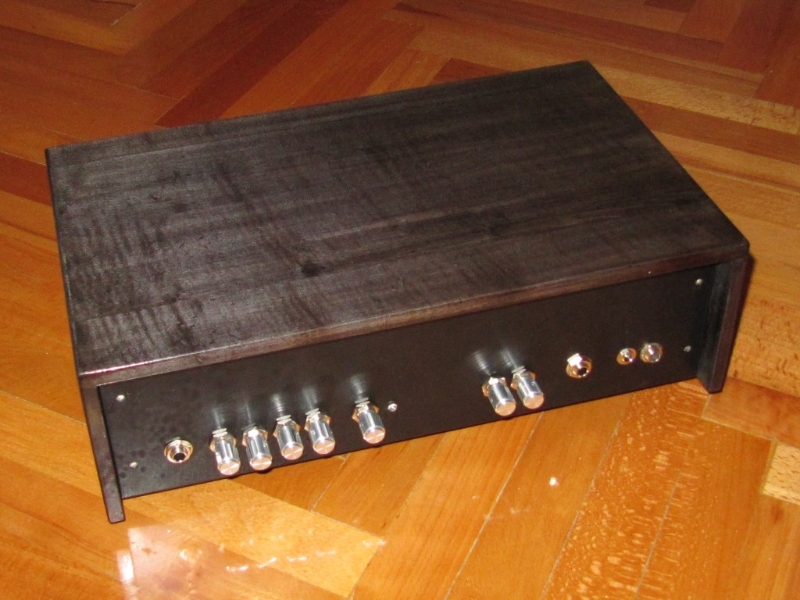
Easy, just add a mono jack in parallel with the channel switch and you can use any latching footswitch to toggle between clean and lead. Just note that for the footswitch to work, channel switch needs to be in the “Clean” position. Otherwise, it will override the settings from the footswitch. On my photos, footswitch jack is the one on the far right.
Want to Build a Single Channel Version?
Even if you are after the single channel version of the preamp, I still suggest using this PCB layout for simplicity (and it leaves room for future upgrade to dual channel). For the single channel operation you can omit some parts from the board and replace others with jumpers. Firstly, you don’t need the 12VAC @ 0.14mA secondary on the power transformer to power the switching circuit. You can omit the whole switching power supply section in the bottom-right part of the board – two electrolytic capacitors, one regulator and one bridge rectifier. You can also omit the clean volume pot, channel switch and indicator LED as well as the three relay protection diodes (marked D1, D2, D3 on the layout). Finally, we want to replace the three relays (RY1, RY3, RY3) so that the circuit is wired in the permanent lead mode. Instead of RY1 we need a jumper that goes between the 22nF cap and 680K resistor by connecting together the two outer pins on the right side of the relay (looking from the component side of the board), and do the same for RY2 and RY3.
Pictorial
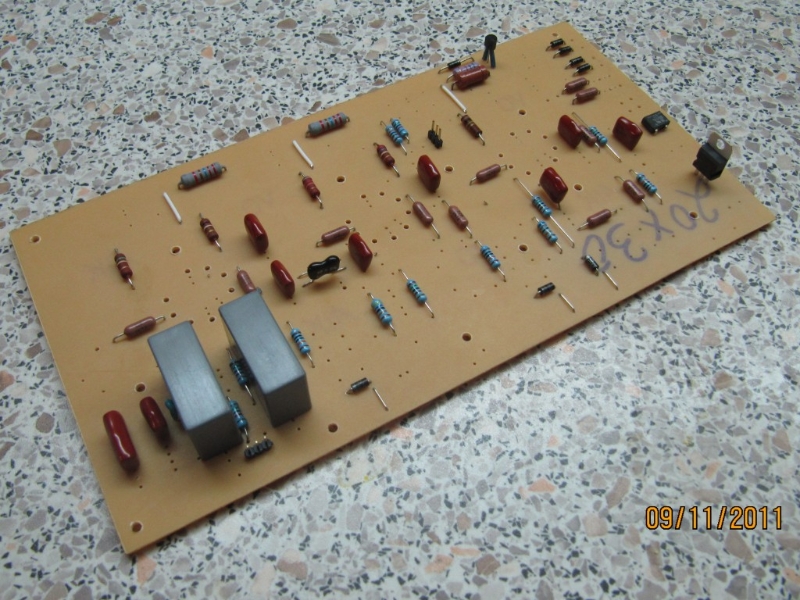
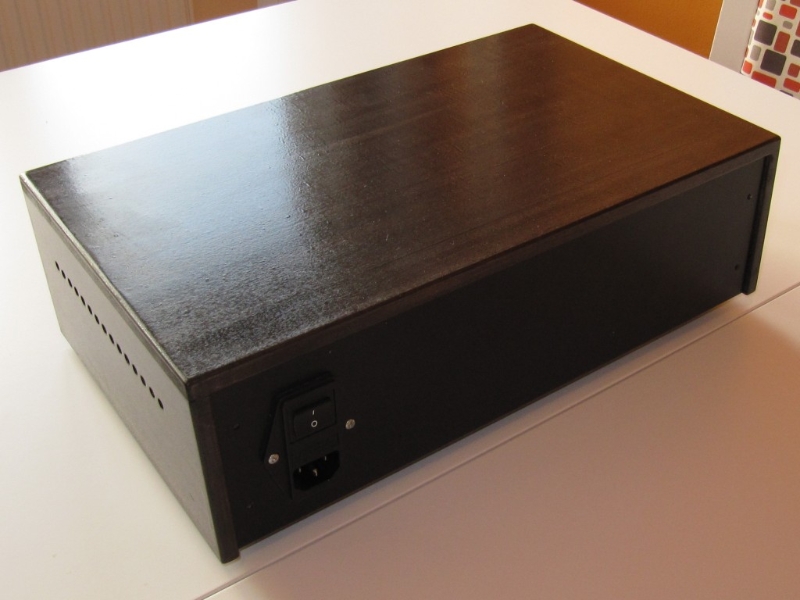
Click on a photo to see more details






Hi Bane,
I just found your website and studied your preamp clone! I really like your build and your great documentation.
I’m also planning to build a versatile preamp and run it through a Torpedo Cab.
I want to include the mesa 5 band eq in the preamp, so what is your suggestion for the output / cathode follower?
Should I just add it after your design?
Have you experimented with other mods/features?
thanks,
sam
I would add a cathode follower at the end of the chain similar to one in my preamp. The original preamp is designed to drive the poweramp, not pedals or cab sims. Torpedo Cab takes line level signal, you’d likely fry it. Make sure you bring the signal down to line level.
I haven’t done anything that’s not documented.
Cheers
Hi Bancika! I’m glad to say that I’ve builted the iic+ preamp and it works fine. I got some questions for you, my Mid pot doesn’t affect the sound at all. On your build this happens too?
Excuse me for my bad english =)
so, got it making some alright sounds. still some issues that need to be debugged you might be able to help with. it oscillates when the lead gain is turned up. it is a low pitch sound and gets lower as gain is turned up. when i play it goes away. when i stop playing is when it makes the noise. makes the noise when guitar volume is up and when its all the way down. im assuming i can replace those jumpers with the 10k’s and that should help?
another issue is it is actually very bright with the high frequencies. i assume its because of the 1000pf treble cap? i have not yet wired bright or fat switch. i also get a lot of gain at low levels on the lead channel and when maxed its pretty hairy with gain. starts sounding like a fuzz pedal a little but with gains dimed.
appreciate all the knowledge. i am using the same grounding scheme that you suggest. grounding the chassis at the input jack.
nevermind! fixed it!
alright, bancika, i built it. here is a link for a youtube sound clip.
http://youtu.be/fBfQk2pgWlQ
https://soundcloud.com/spenser-jarred-shepard/glasgow-riff-mp3
another sample of my build
what is the diode or component you are using for the relay power supply. looks like a black square on the board. can i replace that with actual diodes?
i received spam email and they said they got my email from this website.
also, what type of diodes are you using? are you using the aame diodes for the power supply as you are for the switching?
UF4007 will work for both.
it’s bridge rectifier, just 4 diodes in the same package. Convenient.
thanx. i notice in your layout the 68k isnt present for the heater supply. is that required?
im building the pedal now. made the pcb, populated the board, and im just tieing up lose ends. waiting on tube sockets and the lr8 to arrive. let me know if you wanna see pics or anything.
just leaving an update. i will be building the pcb version of your design. just ordered some stuff to etch the pcb.
Hi
I can’t find cap 33uF 450VAC, can I use 35uF or 30uF?
Please reply on my email: sandro1987@interia.pl
yes
ok, thx for support 😉
Ok, I have mount 35uF cap. Connect all pieces and cables and run it. I used 3 difference sec voltage (300, 12 and 6,3 VAC), used AC heater operation, use 2x 6n2p as a first and thrid tube and 12ax7 as a second (lead) tube as in your project. You can see it on my layout which I add link below. I didn’t use anyone resistor 10k for jumpers 1 to 5 as you can see on photos. Now the problems which I have 😉
1st: Drive and Lead Master pots doesn’t work :/ (I didnt use GND cable in red circles, because where I need to connect it on the board?)
2nd: There is a little distortion when I rise Volume (so I think I will need to install 10k res, but where? 1? 2? because when I use Clean Master there is no distortions)
Please, help me 🙂
Links:
lay: http://sandro1987.dl.interia.pl/final%20lay.jpg
photos:
http://sandro1987.dl.interia.pl/P1060313.JPG
http://sandro1987.dl.interia.pl/P1060314.JPG
http://sandro1987.dl.interia.pl/P1060315.JPG
Hey Bane thanks for the great work! Do you have a chassis ground for the preamp?
I usually ground close to input jack
Thanks. I see the extra hole in the ground trace by the input now. Did you use 250p or 1000p for treble cap?
Hey Bancika, I’m very interested in building in building this pre-amp for myself, though I have a few questions about it:
1. Do you have a parts list for this build? Or can you tell me what needs to be added in addition to the original parts list for the C+ Pre-PTP?
2. If I were to put an five-band EQ similar to the boogie one into this preamp, where would it go in the circuit, before any of the control pots or somewhere else?
3. I had the idea come to mind with the possibility of wiring this preamp into a power-amp based on schematics for a Marshall of the time peroid (modded SLP, JCM 800, etc…) to create what would basically be “Master Of Puppets” in a amp-head. How complicated would be? I’m assuming it’s not as simple as merely wiring the output of your design into the input the power-amp based on schematics, huh? Plus I noticed the lack of the pull knobs that would do something to the EQ or gain, I can’t remember off the top of my head what the pull knob did, but in terms of sound, is this pre-amp similiar to having the knob pulled or pushed?
And also I’m considering to use the Jet-City Retrovalves in place of the 12AX7s. They are quieter and less of a power-sucker than the 12AX7s, would that be okay? I’m still an amateur in terms of fully understanding amp-wiring schemes (I know my way around guitar schematics pretty well though), but I’m very handy and as long as I have instructions to follow, building this wouldn’t be stretching my abilities too much.
Hi ! I have a question , where I can find a Transformer like your ? or can I joint 2 transformers together for obtain 300 VAC ?
You can use two xformers back to back…just do the math. Supply depends on where you are
thank you for your answer , your work is great, and I want build the mark II with your schematics , but the problem for me is to find the transformer , the only way that i can give 300 Vca to the circuit is take 2 transformers ( 150 v + 150 v ) and another 2 for 12 v & 6.3 v , i Italy i can’t find company for making custom transformers , my solution is very expensive .
curiosity how cost your custom transformer ?
You can use back to back transformers one 230:12 to power heaters and to power the other one that is flipped. I guess that 6:230v will give you a bit above 300vac when hooked on 12vac.
My toroid cost 20 euros.
Hey. Do you have any noise issues with that PCB or its noisy with switching? (do you hear switching in your speaker?)
No issues or relay pops
Hey Bancika i have some question for you i will send you something if you can give me your email. I’m making some new preamp with layout based on your for mesa. But need a little help with something.
Fascinating project.
I would like to make a small combo with a 5 band graphic EQ and EL34 se output.
What would be your advice for power supply and cathode follower mod, and also incorporation of the 5 band
Thanx for all your hard work/ thinking.
Rick
If you’re doing the whole amp I wouldn’t change the cathode follower. It’s very useful for standalone preamp, but it could change the way preamp and mesa EQ interact, so I’d leave it alone. As for the power supply, it’s up to you. You could regulate the preamp supply node, it’s not practical to do the whole amp.
Hi!!Bancika!!
I notice that you make the last cathode follower as a FX loop send
However,I didn’t find the return parts
Won’t that cause any problems
such as tone loss?
There’s no return because I don’t have a power amp. Return stage only boosts signal. If I left it in, it could fry any pedals placed after the preamp.
thanks!
one more question
I have a 50w power amp
and I won’t put any pedals between pre and power amp
can I just remove the last stage?
I would still keep it. Power amps typically have gain stage that acts like return stage of fx loop.
Thanks for reply!!!!
Hello Bane, could you please, help me? I have everything triple checked, but all that I got from this is “regulated hum” 😀 The masters are working ok I think.
Got 3x 6n2p-EV
Trafo w/your specs(EI)
Heaters running on 6,3V DC, 7806 regulator hot as f… as you have mentioned. Got wired 1n4002 bridge rectifier, the integrated one was on fire in no time. The tubes are glowing nicely, but I noticed the first (from guitar input), is less hot than other ones.
I’ve noticed today(rewired it desperately) that if I touch the heatsink of 7806 the noise will come down a little and if I strum the strings some signal will go through, but nothing special.
If you could help me via email (you can see it I suppose) or just write it here, I would really appreciate it :).
Thanks in advance
Peter
did some research, found something about ground loops, but no idea what to do
false alarm-no signal at all
Hi Bane,
I’ve got anothe question. How much did you pay for your transformer? Just because I am gonna test my stuff with an big EI one and then I want to replace it with custom. I’ve never ordered custom one, so I’m not able to imagine the price. Thank you 🙂
It was around 15 euros, but bear in mind that I got it in Serbia, custom stuff is not as expensive as some places
Hi Bancika!
Thank you!You did grate job here,and answered all those questions!
Im building this Mark 2c+ preamp and i have almoust done,im using this motor run caps 22uf. and 6n2p-ev tubes,and I have soldered all parts on board,but i have one problem with getting this LR8 voltage regulator!
Is it posible to wire this schematic without LR8,and how it can be done?LR8 needed to lower voltage after rectifier if it is higher then you need.If my voltage is 385v or lower,do i need this regulator?May be i can change LR8 with another regulator?I cant find any other analog of LR8 with same characteristics…
Sorry for my english
Thank you!
you don’t need regulator…the original doesn’t have it. I wanted something a bit different so I went with regulated tight power supply. Shouldn’t be any major difference, just skip it 🙂 Aim for 380-410V and you should be fine
bought it from http://www.tube-town.net very cool site, but shipping is 10€ (DPD) but fast.
To the point, isn’t it a mistake? 7012? Isn’t it 7812? And why not for 6V (7806 then)? (heater elevation)
Almost got it done btw, just need to wire it.
Please, what is a CT You have marked on the scheme. I found out it could be a Center Tap(if I understand correctly, it is a 1 secondary winding with 2 voltages) ??
Thanks for response
I have an EI transformer.(3 sec. voltages)
re: AC vs DC…if done properly, DC will have lower noise level…
yeah, it should be 7812 for 12V heaters or 7806 if you want to wire heaters to 6V, but it’s not for elevation but actual heaters if you want to use DC regulated heaters. CT is center tap in case your transformer has it. In that case you don’t need 100ohm resistors that act as a virtual CT…but that’s for AC heaters
Are there any advantages/disadvantages by running heater AC or DC ? Or is it only to “cool” the regulator, by lower current.
Anyway, thank you for your patience
I’ve read that maximum anode voltage is 300V, and I see 385 V on last stage(buffer i suppose). Is it OK? And what is the purpose of that 100pF cap. used on volume pot?
Thank you for your answer.
re: max anode voltage – 300V is measured in respect with the cathode which is at around 135V, so diff is less than 300V. You also need to worry not to cross the 100V heater to cathode limit for cathode followers, but some amp makers just don’t care (I think mesa is included). That’s one of the reasons I always elevate heater circuit to 50-100V to make that voltage diff acceptable.
first off thanks alot for all you have done bane you literally made me being able to make stopboxes possible and its never been the same since
but i have a couple of probably really nooby questions
first im seeing alot of empty holes ( apart from under the tubes and the heater section if im not mistaken those two bits are a matter of choice right?) are those left open for any particular reason (mostly the ones around the larger cap’s)
secondly im a bit unclear as to what happens in the HV area
and lastly can this be used as a straight amp head and drive a cab or is it for rack mounting and require a poweramp
take care and i cant wait to see what you come up with next
there’s a lot of empty holes to accommodate different sizes of capacitors. There are a couple of holes around power capacitors to add small (say 22nF) parallel film caps in case you use electrolytics (they are said to improve the supply).
This is only a preamp, you need a power amp to drive a cab.
and the HV bit is that just where the transformer connects?
for example would this work fine
https://dl.dropbox.com/u/60093569/layout%20edit.png
i just wanna make sure im understanding the layout correctly
schem is for the version I built and layout is more general. You can use various tubes and transformers. You can wire like you drew and then you need only one 12.6V secondary since you connected heaters and switching to the same pads (those jumpers on far right). I used separate windings, so 6.3V goes to heaters, 12V goes to switching.
ok so i modified the layout mockup to include the transformer im assuming since its vac that the + / – isnt really a problem but if this would work then i finally have a 100% clear idea of how it works and thank you so much for your patience
https://dl.dropbox.com/u/60093569/layout%20edit.png
yeah, the very last horizontal traces are carrying HV
ok last one then i promise ill stop bugging you
on the hv part what are the voltages that go onto those 2 plates i wouldve assumed it was the 300vac of the transformer but then where does the 12 and the 6.3 connect and is that all of them?
(so basicly how does the transformer connect to the circuit)
im trying really hard to kinda translate whats on the circuit diagram onto the pcb layout and i keep getting stuck
Hello, could you, please, send me list of capacitors used in this project?(voltages and types of course).
Sorry for bothering you, but I cannot figure that out by myself, tried that from pix, you’ve posted, but I wasn’t sure about it. It is for my school-ending project due next month, so is very, very important for me, I would really appreciate it :).
Awesome site btw. looking forward to building another stuff, too. 🙂
Hello from Slovakia.
All capacitors are rated 630V except for those motor run caps which are 300VAC or 400VAC IIRC. As far as type, I don’t have such a list. I have it for the first build, sort of…see the schematic. Generally, 1nF and above are all poly film, smaller than that are ceramic and silver mica (used whichever I have. There are only 3 elctrolytics, relay supply and heater elevation…that’s it.
http://diy-fever.com/wordpress/wp-content/uploads/2010/09/mesa_IIc_preamp.png
Thank you Bane for your fast response. I’m a beginner so pardon my stupid questions :). Does the usage of 630V capacitors in places with low voltage any practical reason(effecting the sound for example), or did you use them only for having them around? The same with resistors (high voltage-2W, others 1/2W as for as I know).
Will post some pictures of my progress in some time if you want.(If I manage to get it together of course).
You always want to leave headroom. While tubes don’t warm up B+ can get 50 or so volts higher…
as for resistors, physically larger resistor will have less thermal noise, so some people use 2w on plates because that’s the place where there’s most benefit. You don’t have to do it.
Fantastic. Like your page and projects and also thanx you for inspiring me 🙂 😉 This time I´m doing full version of Mark IIc+ clone, but I’m using eyelets.
Very cool your project! Congratulations!
Have you ever built? Video made?
Again, congratulations!
Greetings from Brazil!
Yeah, it’s complete. I’ll post final photos and some clips when I record them.
For now you can see photos
http://i24.photobucket.com/albums/c22/bancika/inside2.jpg
http://i24.photobucket.com/albums/c22/bancika/inside1.jpg
http://i24.photobucket.com/albums/c22/bancika/pcb_back.jpg
And a quick clip https://soundcloud.com/bancika/little-charmer
Stay tuned
according to the supertex lr8 data sheet, the diode is only required if Vin is less than Vout. also, the max voltage is 480v.
actually, the max is 450v. my bad